Friday, December 24, 2010

GoogleTV

Right now I am watching Youtube on a Google TV. I see some things that should very much be fixed. Frankly the video should be larger,the page itself takes up a ton of space, and the suggestions, those should be a side bar pop-in, same with comments.

Here's a quick screenshot:
and it looks almost exactly like this on the tv, and if all I was doing was websurfing, this wouldn't be a problem, but since I'm wanting to watch video on GoogleTv, I don't want to see this, I'm hoping google will come out with a youtube app that cleans this interface up.

Things like centering the video, and allowing a translucent slide in from the right with a set of suggestions for additional videos. And finally the comments should slide in from the bottom, just a small bar not distracting.

Interestingly enough. Why is it ok to have an interface like this on a regular computer, but when we get to hand held device, or something small, we want a cleaner and simpler interface, the question is, is this how interfaces should look on computers? I mean google got it right when they designed a really simple and clean interface for searching. Google taught us that screen real estate is valuable and as a company they wanted to make sure it was worth it. When it comes to TV, the same holds true.

On second thought why do websites even have search bars anymore? I mean why not push it back on the browsers to simply allow a search function that searches whatever is on the current domains content. If I can find a way to create apps for GoogleTv I think any media sites should be the first targeted, either that or create a "tv." version much like mobile contents. This comes back to the whole idea of content vs formatting separation. Why not just put a bunch of websites together and say "heading" and "video" and then the device that get's it can format it how it likes....wouldn't that be sweet? Well I hope you've managed to follow the off the wall insanity that my posts seem to like to follow. If you have Google TV, what do you like, or not like about it?

Wednesday, December 8, 2010

SPI vs UART vs I2C vs Four Event Protocol

I had to write a paper for my Computer Organization and Architecture course. Its due this evening but if you want to take an early look I've shared it on google docs. I plan to make a few grammatical edits, if you have any additional suggestions or comments I'm all ears.
Here's the link:
Communication Protocols

Monday, November 15, 2010

Coroutines

Today we talked a little about coroutines, at first glance based on the slides it seemed like they were saying that the coroutines would start at the beginning and end when they return, this was a little confusing as they seemed to be identical to procedures.

Turns out we were misunderstanding the picture.

From Wikipedia:
In computer science, coroutines are program components that generalize subroutines to allow multiple entry points for suspending and resuming execution at certain locations. Coroutines are well-suited for implementing more familiar program components such as cooperative tasksiteratorsinfinite lists and pipes.


So what is a Coroutine? Well think of it this way, suppose we have a few programs running in threads, and we have an operating system. Do you think the operating system calls each of these threads to do some work, and when it has to pause and stop to go do something it just starts what it was doing all over again? We wouldn't ever get anything accomplished in computing if that was the case. This is where coroutines come into play, since we can return to the last context that was running we can just keep on running. For example, suppose we have a thread that runs a REALLY LONG for loop, the OS does a context switch and pushes the current status onto the stack. Another thread does some work then returns (or perhaps another thread needs servicing). Upon return all the data that was in use from the function is popped from the stack and back in use again. 


Now the book describes the process in a little more detail, but basically what's happening is that the next address is being pushed to the stack, then the operating system goes off and does some stuff, and pops the address off back into the program counter, and the function keeps running as if nothing happened (to it, the change was transparent).


I hope that helped ya out, let me know if you have any questions.

Friday, November 5, 2010

Circuit Analysis II Lecture 13

****THE BELOW IS INCOMPLETE, but I'm releasing it in case anyone can get some value out of what was written.****
Disclaimer: This series of posts is to serve as notes for myself as well as any others interested in the subject of Circuit Analysis II. This is the course ECE 213 at UNM.
The course will follow the book:
Electric Circuits (8th Edition)


Agenda for the day:
13.6 - AP 13.12
13.7


AP 13.12

x(t) = Acos(wt+phi) is given

Looking at the equation:
vo/ig = ((2+s)s * 10/s)/((2+s)+10/s)

working the algebra through to simplify you get:
10*(2+s/(s2 + 2s + 10))

This is our H(s), so using that H(s) we sub it into our steady state equation:


yss(t) = A|H(jw)|cos(wt+phi+theta)

Now we want to find H(jw) so remember that s = jw so we can just grab w and sub j and w in for s in the H(s) equation, that will look like this:
10(2+j4)/((j4)2 + 2*j4 + 10)

a little manipulation we get:
20+j40/(-16 + 8j + 10)

next we combine and multiply by the conjugate:
(20+j40)/(-6 + 8j) * (-6-8j)/(-6-8j)

finally we get:
2-j4

Converting to polar we get:
4.47e-j63.43


Finally substituting back in our equation we get:
10*201/2cos(4t-63.43°)

Exercise 13.72
we have a resistor of 50 ohms and two inductors whose values are 2F and 8F in series.
vi is attached between the resistor and the 8F inductor. the vo is located across the 8F inductor.

Converting to the S domain and using voltage division we get:
vo = vi/(50+2s+8s) * 8s

Solving it out for vo/vi we get:
.8s/(s+5)

Now we'll sub in 75/s for vi

so we'll get:
75*.8s/s(s+5)

Finishing the algebra we get:
60/(s+5)

Now we want to use the convolution integral on this one:

Circuit Analysis II Lecture 16

****THE BELOW IS INCOMPLETE, but I'm releasing it in case anyone can get some value out of what was written.****
Disclaimer: This series of posts is to serve as notes for myself as well as any others interested in the subject of Circuit Analysis II. This is the course ECE 213 at UNM.
The course will follow the book:
Electric Circuits (8th Edition)


<Concepts:
1. High/Low Pass Filters can be RC or RL circuits depending on what element you are using for vo

a. For RC the Low Pass filter is on the Capacitor.
b. For RL the Low Pass filter is on the Resistor.
c. a/s+b is low pass
s/s+b is high pass

2. Band Pass/Reject Filters are RLC circuits
a. Ks/(as2 + bs + c)

3. The cutoff frequency is A/(2)1/2

4. Q = (L/CR2)1/2

5. wo = 1/(LC)2

To recap:
If there is a quadratic equation on the bottom, it's likely it's a bandpass.
If it's not and there is an s on the top then it's a highpass filter and if not then it's a lowpass.
Don't forget if given in HZ convert to rads/sec via equation w = 2piF

>Examples:
1. Ap 14.1 page 577
2pi * 8000 = 1/10,000c
c = 1/(80000*2*pi)
c = 1.98*10-9
c = 1.98nF

2. Given a 1-10Khz band, C=1uF what are R and L
1/LC = wc1 * wc2
LC = 1/wc1 * wc2
L = 1/C*wc1 * wc2
Solving we get 2.53mH
From there we use the equation R/L = wc2 - wc1
Remembering 2piF = w,
R = 2pi*L*(9000)
R = 143.06 ohms

3. 14.20 page 602
Given c = 20nF, Q = 5, wc = 20kHz
(20000*2*pi)2 * 20*10-9 = 1/L
L = 3.17mH
5 = (3.17*10-3/20*10-9*R2)2
25 * 20*10 = L/R2
R = (1.25/394784176044)1/2
R = (3.166*10-12)1/2


ECE 340 Test Review

****THE BELOW IS INCOMPLETE, but I'm releasing it in case anyone can get some value out of what was written.****

So I have been looking at the explanations for the first problem, and right away I believe looking at the problem and analyzing it will go a long way in this case.

1.
a) Looking at the first part of problem 1, we see that it says "What is the probablility that both engines fail during the marine mission". 
Let's break the first question up into parts, Reading Both implies that we are looking for an intersection. From the introduction to the question we know that given one engine failing (the first engine) the second one fails with a probability of .1, Thus the probability of A given B is going to be .1, and we know that B is .0001, now we can say that P(ANB) = P(A|B) * P(B). Which equates to .0001 * .1

b) Breaking down "suppose the second engine fails during the mission what is the probability that the first also failed".
We can extract that we are looking for the case where P(B|A) we are looking for B given A in this case, we also know that the probability of that is = to P(ANB) / P(A) we are looking for the case where there is an intersection over the probability of just the second. This can equate to (.0001 * .1)/(.0003)

c) Looking at "What is the probability that at least ONE of the engines fail" we can extract we are looking for the UNION of the two, Because of that we know P(AUB) = P(A) + P(B) - P(ANB) we know each of the elements here, so the solution is .0003 + .0001 - (.0001 * .1)

d) Breaking the sentence "What is the probability that the first engine fails, and the second engine doesn't fail during the mission" we can extract that given A we are looking for the probability of A sans B, so that would be P(A) - P(ANB) this equates to .0003 - (.0001*.1).

2a. A group of 30 people shake hands with everyone else once,
Looking closely at this we are looking that person 30 shakes hands with 29 people, person 29 shakes hands with 28 people(can't shake 30's hand again), and so forth, so the total number of shakes that occur would be the summation of 30 .. 1 , since we can't really make an easy estimate on this one, then subtract the appropriate number of hand shakes this comes out to n(n-1)/2 or 435. Realistically if you think about it the last person can't shake hands with anyone else so I think the final result should be 434

2b.
Since the elements of the "even" set contains 6 elements {3152, 3512, 5312, 5132, 1352, 1532} and the entire sample space contains 4 varieties of that (one for each number) then the total elements are 24, this will give the solution 6/24, which is 1/4. I didn't bother to calculate the number of elements in the sample space for various reasons. BUT I did have the solution correct in that I said it was 6/(cardinality) of the sample space, which is in fact the correct answer.

3.
Since we are trying to figure out what the probability of two students having the same birthday, we can say that the solution would be (365*364*363...335) divided by all the likely scenarios of 365, which is 365^30.
so the solution is 1- (365! /335! ) / 365^30

4. 
a. { (1,1), (1,2)...(1,6).....(6,6)}

b. Since we are looking at all the EVENTS (I read outcomes on the test....durr) we can have 2^36 different variations (since there are 36 outcomes)

c.  the event that the max of the two numbers is 2 would be {(1,2), (2,1), (2,2)} the probability of this is E^#/Ohmega^# or 3/36

d. The event containing the minimum of the two numbers being 2 is {(2,2),(2,3), (2,4), (2,5),(2,6)...(3,2)} this is 4*2 + 1, 9 outcomes,the P of this is 9/36

e. IFF P(E1NE2) = P(E1) * P(E2) then it's independent. since the intersection is (2,2) and the probability of (2,2) is 1/36, P(E1) = 3/36 and P(E2) = 9/36 so 1/36 != (3/36 * 9/36) thus they are independent.

f. Given E2, we can expect that the probability of getting E1 is the intersection of the two / cardinality of E2 so the solution is (1/36)/(3/36) = 1/3

5.
a. Decoding this we are looking for a zero to be received, this means we are looking for the intersection of the Event that a zero was received with the event that a 1 was transmitted and received as a 0 and the event that 0 was transmitted and received as a 0.  This gives P(0RN1T) + P(0RN0T) = P(0R), we also know that P(0R|1T)*P(1T) = P(0RN1T), and the same goes for the other one, so we now can say that P(0R) = P(0R|1T)*P(1T) + P(0R|0T)*P(0T) which plugging in the numbers we get P(0R) = .6*.001 + .4*(1-.01) = .3966

b. Decoding what is the probability that a 1 transmitted given a 1 was received.
We are looking for the event where a 1 was transmitted given a 1 was received this gives P(1T|1R) this can be equated to P(1TN1R)P(1T)/P(1R)which is saying that we are looking at the probability of the intersection occuring times the probability a 1 was transmitted, divided by the fact that a 1 was received. Since we know the probability that a 0 was transmitted given a 1 was received, we can say that the "opposite" would be 1-P(0T|1R) also since we solved above the event that a 0 was received we should be able to plug that in too which nets us: 1-P(0T|1R)*P(1T) /  1-P(0R) these come out to (.99 * .6 ) /.3966  is approxmiately 1.5.

c. Since .6 of the bits will have .001 chance of error, and .4 of the bits have .01 chance of an error, we are looking for the intersection of the error since a bit transmitted as a 1 can't be "converted" to a 1, we can say the sets are disjoint, and simply add the probabilities together, so .4*.01 + .6*.001

6.
Given that P(A|B) is independent we can say P(A|B) = P(ANB)/P(B) since they're given as independent, we can say that P(ANB) = P(A) * P(B) replacing that in the equation we can say that P(A|B) = P(A) Since the P(B)'s cancel out. the same will hold for P(B|A) which will equal P(B)

7.
a. Trying to decode this question we're looking for the case where a 1 was sent, this means that the majority must have ruled in our favor, so we would have to do N choose K for 4,5,6,7 and multiply appropriately (p^k)*(1-p^n-k) this would give us the solution

b.
The probability of a number being a heads (using the above sample space) we can assume that the probabilities will be the summation of the N choose K for 1,3,5,7, solving for that, I can only assume that for all cases where the # is even, is 1-P(odd).

Insert Graph here:


8. 
i. As defined in your lectures a random variable is a mapping of the elements to the real number set. thus the answer is b)

ii. As defined in the book/lectures p(F1uF2) is = P(F1) + P(F2) ONLY if the intersection is a null set, thus the solution is b)

iii. I immediately recognized the equation to determine independence (c), BUT I didn't think there would be more then one, and didn't really look, obviously P(F1UF2) = P(F1) + P(F2) - P(F1NF2) I didn't look closely but you can "swap" P(F1NF2) with P(F1UF2) (using simple math), I'm blind and didn't see this on the test, so the actual solution is f, C and E

iv. I spoke with you in this class, since I didn't know if F=G I couldn't determine if the probability of F was equal to that of G, from the sounds of things we SHOULD have assumed F = G which means the probability is P(G) <= P(F), this gives the solution b, BUT assuming that F = G, then isn't the P(F) = P(G) and it's not "less then" since they're literally equal to each other?


Tuesday, November 2, 2010

Page Replacement Algorithms

There are many page replacement algorithms, this week we were asked to implement the fifo and lru page replacement algorithms. But, first a little primer.

FIFO Page Replacement
The fifo page replacement algorithm is essentially a queue setup that pushes the first items into the list out first when the list is full, so for example, if you have the numbers 1,2,3 and they are put into the array in that order, when the 4th number comes along your 1 gets pushed out, and you are left with 2,3,4. That simple!

The FIFO page replacement algorithm was pretty simple to implement, all I had to do was create an array that was the size of my frames, then I simply setup a "current pointer" to that array head initially, and a pointer to the tail and head of the array. When we found a frame we didn't do anything. When we didn't find a frame, we simply assigned the data to the current pointer then moved the pointer down the array, when we reached the bottom, we simply moved the pointer to the top and repeat, also we increment our page fault counter. Something interesting to note, supposing we have the next element in the array that matches so we don't have a page count increment, well the next go around, and that one will still get written over. Since this element wasn't recently written, it doesn't get to keep it's status as "new", and still can be written over in the next iteration. This seems a little less then efficient, however perhaps changing it a small bit so that it skips over to the next element would be beneficial.

LRU Page Replacement
The Least Recently Used algorithm basically makes an association for each array with a clock. The book suggests this is easy to implement using a doubly linked list, the other option is counters.

The LRU page replacement algorithm in theory was pretty easy too, and really looking back on it, it really was. I simply decided to make a second "timing" array that matched up with the frame array. This way whenever we did a frame check, we refreshed the matching frame's time, and if the frame wasn't there, we put the new one into the frame array, and then updated our clock. Really I was able to keep a lot of my code from the fifo page replacement and reuse it, as a lot of it was simply "setup" and structure stuff that I could easily reuse.

Caveats
This sounds really simple, but I did have a few problems along the way one of the main problems I ran into was operator precedence. This occurs when you have + and * in a equation, or a ( or something like that, the compiler/processor has to know what to evaluate first, if for example you try to increment a pointer that is routed through an address, like so *ptr, and you attempt to increment *ptr++, you are actually incrementing your address, effectively losing the pointer to your pointer. This is simply fixed by (*ptr)++; since the ( has higher precedence then ++. Another issue I ran into was that using the function clock() just didn't want to cooperate, clock ran just way too fast, so I had to put wait's in there so that it would adjust the clock even minutely so that when we assigned it to the arrays we didn't use the same time on numerous ones. That makes it hard to find the oldest one if they are all matching times.

Good luck and let me know if you have any problems!

Saturday, October 30, 2010

Virtual Memory

So we were asked to devise a way to figure out which page a particular physical address was in, as well as it's offset.

Turns out this is a really simple problem, in this case each page is 4kb, which really means 4096 bytes, so simply take the address, divide by that 4096 bytes, and that tells you which page it's in. From there you subtract the number of bytes of the previous pages (4096 * n)  from the address and you get the offset.

So the nice thing about virtual memory, is that you basically always know your address will reside within a 4096 byte address. This can make more static stuff easier to handle, rather then trying to guess which physical address you are, then figure out some kind of offset.

Here is the program I wrote in action.


Well I hope you enjoyed, I know it was a bit short, but the problem was really easy to see a solution, if you're having problems understanding how to find a page and offset, please let me know and I'll do my best to help!

Bankers algorithm

The Algorithm
The bankers algorithm seems to be a pretty simple algorithm, essentially what you do is have some defined amount of resources, and then you kick off a bunch of threads, now if there are resources left, the thread can run and do it's thing, but if there are no resources, the thread must wait.

Deadlock
The key here we need to ensure is that there is no possibility of a deadlock. A deadlock occurs when two processes are waiting on each other to run. This can happen if we lock the mutex to try to see if we have resources, and then we don't let it go if the resource doesn't exist. For example the following situation would produce a deadlock.
1. thread 1 locks the mutex, gets the last resource, and unlocks the mutex.
2. thread 2 locks the mutex, no more resources exist so, thread 2 waits for resources, (not unlocking the mutex).
3. thread 1 is finished doing it's work, and needs to return the resources. It trys to get the mutex, it's blocked until thread 2 is done, but thread 2 won't give up the lock until thread 1 is finished.

This can be avoided by forcing thread 2 to lock the mutex, check for resources, unlock mutex, then check again if needed by doing it all over again. Now when thread 2 locks the mutex, and thread 1 tries to lock it, thread 2 releases it shortly later, and then thread 1 gets it, finally the next time thread 2 comes to lock the mutex, it now has resources and can run. See? Deadlock resolved!

Additional Thoughts
Reading up on the bankers algorithm on wikipedia, it defines that each thread should declare how many system resources it will eventually need, and if the number of resources it needs is more then the system has remaining it must wait until the resources are available, since my implementation only requests one resource at a time, I didn't see the need to declare how many it would use. But my understanding of this is that the thread has itself a max number of instances allowed, so it has a max that it needs to check on. So essentially there are two resources each thread needs to handle, a system and a local, if it exceeds the local, this is an error condition, so it needs to be handled appropriately, if it exceeds the system, again it's an error and needs to be handled appropriately.


Bankers Algorithm Running
The fact is that I had way too many lines running to show it all, so I redirected the output, here is what is printed out.

Customers are coming..............     
Customer Created..............     
Doin Something Time Consuming..............     
Customer Created..............     
Doin Something Time Consuming..............     
Customer Created..............     
Doin Something Time Consuming..............     
Customer Created..............     
Doin Something Time Consuming..............     
Customer Created..............     
Doin Something Time Consuming..............     
Customer Created..............     
Doin Something Time Consuming..............     
Customer Created..............     
Doin Something Time Consuming..............     
Customer Created..............     
Doin Something Time Consuming..............     
Customer Created..............     
Doin Something Time Consuming..............     
Customer Created..............     
Doin Something Time Consuming..............     
Customer Created..............     
Waiting until all customers are gone..............     
Doin Something Time Consuming..............     
Time to go home..............     
I hope you enjoyed the information! Let me know if you have any questions!

Thursday, October 28, 2010

Register Renaming

What is the purpose of Register Renaming?

The goal of register renaming is to allow blocks of instructions to be executed out of order.
Take for example the following instructions

1. divd r5, r7, r12
2. addd r6, r7, r8
3. sd r6 0(r1)
4. subd r8, r14, r12
5. muld r6, r15, r8


Looking at these you can see that  without register renaming you have to run the instructions in the sequence 1,2,3,4,5. However if you note, lines 4 and 5 don't depend on 1,2,3. The issue is that if they run before 1,2,3 they will clober the data that 1,2,3 are trying to calculate with.

If we simply rename the registers r8 and r6 in 4,5 we can remove that dependency.

This type of dependency is called a false dependency, because the only thing preventing them from running out of order is simply you are using the same registers, not the same data.

Now look at this:
1. divd r7, r5, r12

2. addd r6, r7, r8
3. sd r6 0(r1)
4. subd S, r14, r12
5. muld T, r15,S

Now the instructions 1,2,3 can occur independent of 4,5. Since there are Read after Writes (RAW), and Write after Reads (WAR) the instructions within the 1,2,3, they must occur in order.
for example, the following orders are now valid.
a. 1,4,2,3,5
b. 4,1,2,3,5
c. 1,2,4,5,3
...
The only requirement now is that 1,2,3 occur in succession, and 4,5 occur in succession for example
the following executions are invalid
a. 2,1,4,5,3
b. 3,1,4,2,5
The reason is because the instructions are data dependent on each other "in" those blocks of code.

Any questions? Just go ahead and ask.

Sunday, September 26, 2010

Threading and Mutexes

So the overall assignment this week was more or less the same as last week, make your main/parent program call a thread to do the fibbonacci work. That was easy, so easy I did it at 3am friday morning when I couldn't sleep, in about 30 minutes, it took a little bit of rework from the fork program I wrote last week, but was simple to implement.

This morning I was thinking about mutex's.  I know that you use a mutex as a semaphore of sorts in that when you've locked it other processes needing to use it (or really use some variable you're about to modify) won't be able to.

So what I did was lock it in the child thread, then when the sibling thread attempts to lock it, it can't, and then forces it to wait until it's unlocked once the child unlocks then the sibling can print the elements of the shared memory.

Remember to include pthreads, you simply have to #include
then to compile it would be gcc -pthread -o filename.o

Good luck!

Here are a few screen shots of the results.
Fibonacci Threaded

Fibonacci with Mutexes

Tuesday, September 21, 2010

Books I would like to read 9/21/2010

Here is a list of the books I would like to sit down and spend some time reading front to back.

Let me know if you have one on your list that I would like.
Pthreads Programming: A POSIX Standard for Better Multiprocessing (O'Reilly Nutshell)
I've poked through this a bit, my buddy Phil lent me the book, and I would really like to get through it, maybe I'll knock a few chapters down this weekend if I don't have too much homework.

C Programming Language (2nd Edition) (K and R C, the definitive guide)
I borrowed this from the library at work, but only got a little into it, unfortunately work and school come first.

Mastering Regular Expressions
I borrowed this one from work, and got through the first 3 or 4 chapters, but then it started getting into the greedy etc matching and I kinda slacked off, I would like to finish this book as what I've learned from it so far has been INVALUABLE.

Linux Device Drivers, 3rd Edition
I have the second edition of this book, and it's a great book, but it only covers up to the Kernel version 2.4, the 3rd edition however covers up to 2.6 so that's great news. There is a free version of the book here: Linux Device Drivers 3rd Edition *Free

I'll give you my next list. If you've read these books give me your opinion, or maybe suggest a better one in place of the ones I've selected.

Saturday, September 18, 2010

Operating Systems -- A shared memory project

Well I decided to start hacking away at my homework for my operating systems class, in the course of about 3 hours, I managed to finish the project and make breakfast....All in all I would say it was a productive morning.

I am not going to share my source code, for reasons I'm debating about writing a post about, to make a long story short, is it ethical to post about your homework? I do think that sharing knowledge in this day and age is what will enable us (humanity) to become smarter as a whole (I think), however there is a line, explaining about shared memory for example and how it works, with examples is valid, literally posting my code up for people to simply copy and paste into their HW not so awesome.

Lets get into it, as part of the assignment we were asked to record our observations and the likes.

First off, the first problem wasn't really all that hard, initially I started to do it recursively, but decided not to, as I was just not thinking right this morning, and writing a simple for loop to do this was WAY easier.

Lets get into the meat of the project, the two main goals were forking and shared memory, the forking was relatively easy, simply creating a variable to hold your pid and then checking whether it's 0 or some other number tells you whether you are the parent or not. Then simply doing something different based on whether you are a parent or not (or if there was a pid error) was all that was required.

Shared memory was a little trickier, and I think I finally get it. Here is the deal, first we create a numerical identifier for the shared memory. Now we can begin to fork, and in the child process we create an attachment to the memory in each child process, THEN in the parent we do the same (This way we KNOW we aren't using the shared variable, it's actually memory, because we're using two different variables and I didn't assign them as pointers).

Now when you're done in the children we just detach from the processes.

In the parent we will detach then deallocate the memory. I was thinking about it, and I decided in my mind that if i deallocate that memory, then still try to point to it with my variable, I should get a segfault, guess what... I did, so that's how my program ends, with a seg fault, but it's on purpose, and I actually know why, and it just plain makes sense. Heres the output of each of the parts of my program.


Part 1
Fibbonacci with only forking
Part 2
Fibbonacci 2 with shared memory

Thursday, September 16, 2010

Kernel Modules

My ECE 437 class was assigned the monumental task of writing a filesystem driver for the linux kernel. I did a LOT of reading and finally started writing a few things, but realized I needed to be able to simply compile a kernel module just to see how to do it so I started following along with the kernel module how to here Kernel Module Tutorial

When I ran into the problem where when I called make, I would see the following error:
make[2]: *** No rule to make target `kernel/bounds.c', needed by `kernel/bounds.

I chased around the interwebs for a bit. I found out that it looks like $(PWD) wasn't returning the present directory, so I updated it to shell pwd per this site: Labjack Forums

Here is my makefile (note that in front of commands are TABS, if you replace them with spaces your makefile won't work, you've been warned)

#!/usr/bin/make -f

obj-m += hello_world.o

KERNELDIR=/lib/modules/$(shell uname -r)/build

all:
make -C $(KERNELDIR) M=$(shell pwd) modules

clean:
make -C $(KERNELDIR) M=$(shell pwd) clean


And finally here is my hello world (keep in mind it's pulled from the above tutorial)


/*  
 *  hello_world.c - The simplest kernel module.
 */
#include /* Needed by all modules */
#include /* Needed for KERN_INFO */

int init_module(void)
{
printk("<1>Hello world 1.\n");

/* 
* A non 0 return means init_module failed; module can't be loaded. 
*/
return 0;
}

void cleanup_module(void)
{
printk(KERN_ALERT "Goodbye world 1.\n");
}


Check it out. and give it a try. hopefully it works for you!

calling make all at the command line should compile it all,

and then a simple sudo insmod hello_world.ko

check out if your module was loaded via lsmod, look for it.

Now check your /var/log/messages file for your alert!

Finally do a sudo rmmod hello_world.ko to remove it from the kernel.

Thank you Caleb for the help various commands and the makefile!

Friday, August 27, 2010

Car, Mp3 Player integration

Anyone reading this that knows me knows I take forever to finish a project, in fact I have many projects that are in the slow (I mean glacier slow) process of being worked on.

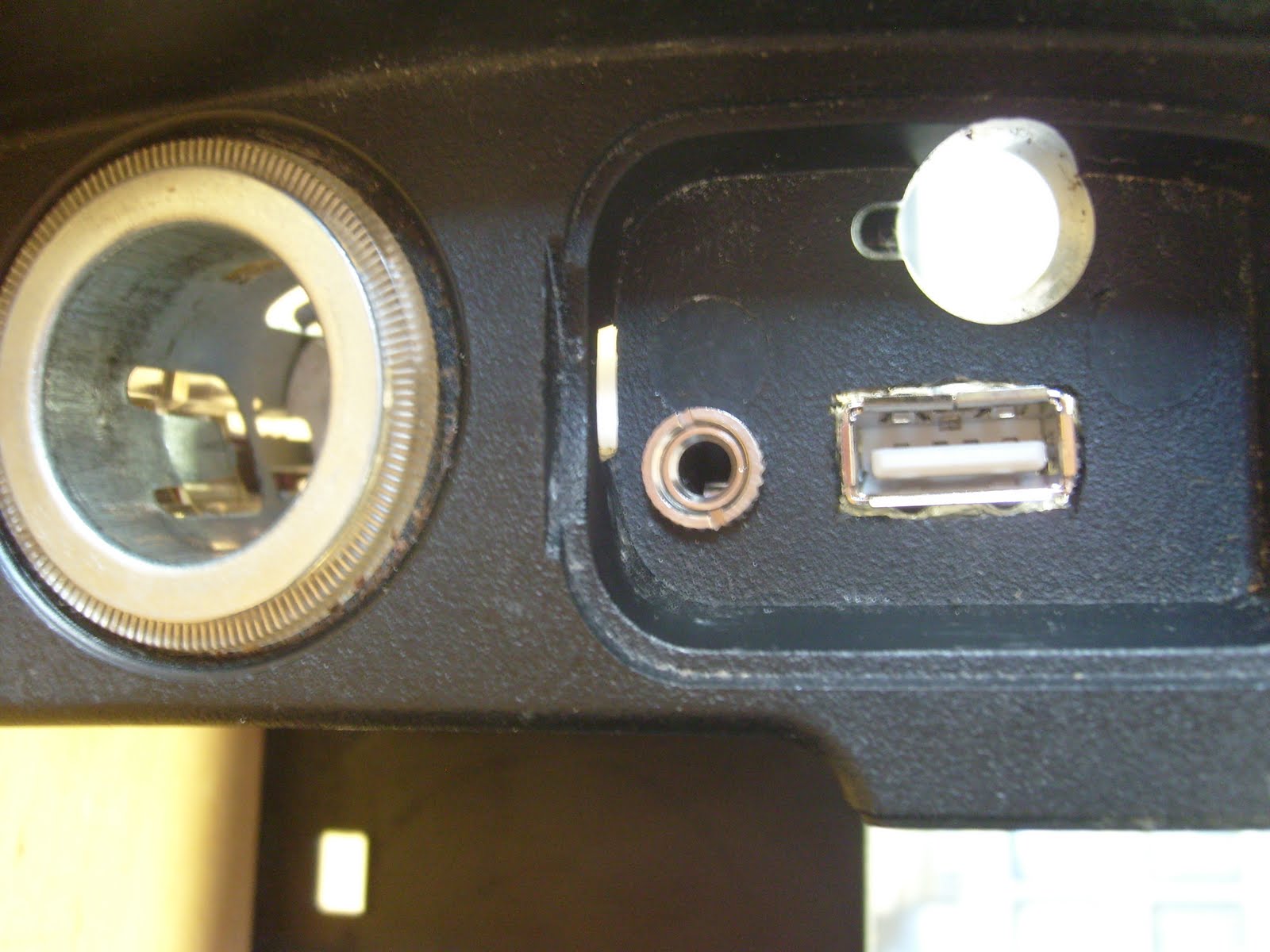
I finally pushed myself to finish my mp3 player integration with my car, I had started this project probably 2 years ago easily. I, for the longest time, had wires hanging out from my console with a plug so I could plug in my iPod, also the ground was being run to my cigarette lighter.It looked TERRIBLE. I finally tore my console apart earlier this summer, and worked feverishly for a few weeks trying to get the USB port mounted, and then working on the audio jack. Summer classes began and I had no vent in the middle of my air outlet in my car so the air just blew anywhere it felt like. This killed my wife (not literally) as she tends to be colder then me pretty much all the time.  I finally kicked myself in the butt and realized that I wasn't going to get the USB working until sometime in the future, so I decided to just finish what I had so at least it looked nice.

I present to you the following:

While finishing up the cables from my cd player, I realized i needed some way to connect the two cables, I could use some kind of plug but while looking at my parts I realized I had RJ45 jacks and all I needed was a straight through network cable and I could connect through. To the left is the jack connected to the plug.

Here is the bottom side of the jack where I had to connect it through.

Here is the inside, I have the usb plug put in. I just need to build a charging circuit, and the actual audio jack.


And here is the whole thing connected up one last time before I put it all back together.


 Here it's in and I'm about to finish putting the faceplates back in.

 and finally I have the whole thing put together and running, it sounds good and looks pretty darn nice.
As a note I want to put here in case I ever have to look into this again, I have whiteblue and blue hooked up to the return, the green and whitegreen are the tape in, the brown is the ground, and when I plug the audio from my iPod in it goes to the blue, when it's unplugged the green/whitegreen combo are connected to the whiteblue/blue through the jack. 

If and when I ever build a tiny power supply and get my USB charging circuit going I'll be sure to let you know.

Friday, August 20, 2010

Rant about Schedules

So I have to rant here about UNM, for just a moment, So far I have had 2 semesters in a row (last spring and this summer) where I have registered for a class, with a TBD teacher. We found out the monday of the first week of class over spring, and found out a week early (I believe) that our summer class had changed times. If all I was doing was going to school, this probably wouldn't be a big deal, but like many others in the Engineering Program we have jobs, and finding out the day of a class that the time has changed (to earlier or later). is a HUGE hassle for people.

I just wish UNM seemed to understand it, I went to CNM for 3 years roughly, and don't recall this happening EVER, and I don't understand how a University can't plan classes that are reoccuring for a DEGREE program on a consistant basis. it just doesn't make sense....sorry for the rant but I had to put it out there.

This is my "theoretical" schedule, but if they change the two classes I have at the end of my tuesday and thursday, and monday wednesday courses I'll be hosed....standby we'll see what happens monday.


UPDATE: Well class has begun, and I'm honestly surprised. The classes times have not changed, I'm a little disappointed that the money being paid for a class to be taught by a instructor is being taught by a PHD student, BUT he seem like a good guy, so hopefully I'll get an opportunity to learn a bit off him.

Thursday, August 19, 2010

My 30 minutes

Ok I spent a little more then 30 minutes working and thinking about projects yesterday, as well as organizing my workspace, so I'll detail a little about what I did.

1. I got my Open Bench Logic Sniffer working, That was a HUGE hurdle, as I really wanted to use it for reading chips on my arcade to see that everything is working as planned.

2. I thought about how I can use my latching hall effect sensors. I wanted to build a gear indicator for my motorcycle, but thought I would need to buy a new set of hall effect sensors because i didn't research the ones I purchased well enough. (There is a lesson here, make sure you research what you're buying, this can save you time and money). For these hall effect sensors I'm going to figure out how much time removal of power will take to reset the sensor, then everytime I see a logic 1, I'll reset the sensor, it's not fancy but I think it'll work.

3. Cleaned up my workspace a little more again, put all my LED's in bins, as well as my resistors, rather then leaving them on the tape reels and baggies.

Also being without internet is rough, I now know I need to download all my datasheets for all my chips, sensors, etc. so when I'm home I can hook things up, not having things like my Quick Reference Guide for programming my PIC16f913 was a real hindrance to progress yesterday, maybe if I have a little time I'll get to play a little more tonight with it.

Tuesday, August 17, 2010

Getting Started

The Hardest Part
What's the hardest part of doing a project in your free time (especially when you're not a motivated person in general)?

Getting Started.

Over at the simple dollar trent makes the statement:
Big goals, big dreams. None of them will happen until I sit down and make the decision to get started with them. I can dream all I want, but until I get started, nothing will happen.
The Key
This is key to what I've said before about getting started, start spending time on what you're passionate about. Trent makes the challenge to go home and spend 2 hours on the big thing you're dreaming most about in your life.  This reminds me a lot about what my dad said about working on our backyard. Looking at it from the perspective of the whole project it looks like it's going to take a lot of work, but if I spend 30 minutes a day on it, you realize it goes a lot quicker then you really ever thought it would. The beauty of it all? It only takes 30 minutes a day. If you can't spare 30 minutes a day about something you really genuinely care and dream about, it really can't be that important to you.

Directing Focus
I like to think of it this way. I used to spend my "relaxation" time just watching tv. But I found myself getting more and more restless. Why? I don't care about watching TV, and unless I am specifically watching TV for a specific show, I just start to get mad at myself. I might complain because I have a bit of a belly, but I don't work out hardly ever. Bam 30 minutes a day, and I bet I could start to fix that. What is 30 minutes? 30 minutes is 2% of your day roughly. Start focusing your time on what you care about and you'll find you have more time. All it takes is a little bit of focused time each day. I truely believe that my "relaxation" time will become the thing I'm passionate about. and the more I

My Project
For my Car project I have some specific things I need to finish, but just getting myself up and doing them can be a challenge. So here is how I'll start finishing things, I'm going to map out what I have left and start making plans to complete each piece.

1. Program my PIC 18F4550 to determine if I can emulate a COM port. If not Use a 16F913, and use true RS232.
2. Using the PIC 18F4550, communicate with my CAN bus chips. (Or 16F913)
3. Find out the CAN messages that my car will produce when I press the song change buttons, as well as various other buttons. (Map out the entire CAN message structure if possible).
4. Hook up my USB port I installed in my car with the right resistances to charge USB devices.
5. Integrate iPod Touch Control with Microcontroller.
6. Use Messages determined in 3 to convert and send to my iPod with knowledge from 5.
7. Determine how to "trick" my tape deck into thinking it's got a tape in it but don't require the motors to be running. (prevents the terrible noise of the motors spinning).
8. Clean everything up and make it look professional. (Possibly cable channels or wraps to make the wires look clean.

School starts in about a week, so finding time is going to become challenging but I know that I can do it.

Wednesday, August 11, 2010

Google Voice Beginner

Well I went home to visit this weekend and my mom still had no idea what she was doing when it came to Google Voice, so I did what any good son should to and made a quick guide. This thing is by no means professional, nor is it even remotely perfect, but it was able to start her in the right direction again, so I am going to post it here for the benefit of others, I'll be updating it again as I get more questions.

Google Voice Beginner Guide V1.0

Thursday, July 22, 2010

Adventures in Prototyping a Board

So I'm working on a reconfigurable programming board for my microcontrollers.  Here is a quick shot of it.


So it's mostly a breadboard in some ways...LOL, but mainly I wanted the ability to have a ICSP connection and I was originally just going to directly connect it underneath to the right pins for the pic 16F913, but decided to just put a header on the other side of the ICSP header and then I can run wire and reconfigure it, as needed. This gives it a little more flexibility, and I don't have to disconnect and try to figure out which wires went where whenever I disconnect the ICSP header from the board.

The benefit to this is now I can program my Pic 16F684, and any other 28 or less pin PIC, I would like to add a power header to the board for additional hookup, but for now this will work I believe, and fortunately I will have the freedom to add to it as needed.

Parts required:
Perf Board from Radio Shack
Headers from Electronics Parts in Albuquerque
IC socket headers from Electronics Parts in Albuquerque
Solder (obviously....hmm wonder if we can come up with a solderless compound....ohhhh I like)

What if you put a lot of conductive material in a superglue form for example, you could "solder" by literally no heat....ok I'm talking crazy. Have a great day.