Friday, October 30, 2015
Programming Anywhere: Chows Asian Bistro
In continuing to find good places to work, I have found Chows Asian Bistro to be great. If you are in on the weekend nights, you get treated to live piano music, which is just AMAZING. They seemed receptive to my working from there, I suppose if more people showed up to work (but also bought food) they wouldn't complain. It's the folks who show up order a tea and hold seats for hours, don't be one of those. Some of the seating is in the right spots that it's easy to not get distracted when working. Aim for one of those seats.
Pro's: Great Music, friendly folks AMAZING food (well it's my favorite Asian food in Albuquerque, probably the world).
Con's: You really should support the business and not just take up space. No Wifi (That I found)
Stay Tuned I'll be talking about Rudys BBQ next week


Wednesday, October 28, 2015
Numpy Array Size, and ValueError
I just wanted to capture this for others as I'm not sure the *correct* solution but it appears that trying to use a very large array within SKLearn's kmeans seems to cause a problem.
When I reduce the size of my input by a bunch (I had roughly 246 features, and 3500 lines), the code begins to run correctly (I have a smaller input size for another dataset, that has the same setup except 6 features not 246, and is shorter, no problems there).
Good luck
UPDATE
Open your csv input in excel move to rightmost column, now one more over. Hit crtl and down arrow, if you have incorrect data, youll find more elements, if you load a csv like i did
Traceback (most recent call last):
File "..\School\GeorgiaTech\Assignment_3\live_pca.py", line 167, inodule>
k_means_results('Live No Feature Selection', [X,y], [X_test, y_test], colorm
ap = False)
File "..\School\GeorgiaTech\Assignment_3\live_pca.py", line 60, in k_m
eans_results
fit_results = k_means.fit(X)
File "C:\Python27\lib\site-packages\sklearn\cluster\k_means_.py", line 785, in
fit
X = self._check_fit_data(X)
File "C:\Python27\lib\site-packages\sklearn\cluster\k_means_.py", line 755, in
_check_fit_data
X = check_array(X, accept_sparse='csr', dtype=np.float64)
File "C:\Python27\lib\site-packages\sklearn\utils\validation.py", line 344, in
check_array
array = np.array(array, dtype=dtype, order=order, copy=copy)
ValueError: setting an array element with a sequence
Good luck
UPDATE
Open your csv input in excel move to rightmost column, now one more over. Hit crtl and down arrow, if you have incorrect data, youll find more elements, if you load a csv like i did
Friday, October 23, 2015
Programming Anywhere: Food Court At The Mall
Being crazy jam packed with school I've had to sneak away to work on projects/homework. Typically in Albuquerque Flying Star is the defacto standard for studying/etc. I love the place but haven't been loving the menu choices, so I decided to start trying other places out.
The first place I tried food court at the mall. I got in around 9 or 10 even though stores aren't open often times the mall is open to allow for walkers, this means you get a quiet place to work for a few hours. In the case of my mall there were a few free wifi locations so I was able to do any looking up of things I needed to. If you're in a pinch this is a place to try out.
Pro's: Early and late enough it's quiet and easy to get work done, well lit. Don't feel bad about not buying things to support a business (you're not taking up valuable customer space really). You can usually find Wifi
Con's: As the day goes on, more and more people show up. If you're distracted easily this is probably not the place for you.
Stay tuned. I'll be talking about Chows Asian Bistro in the next post!
The first place I tried food court at the mall. I got in around 9 or 10 even though stores aren't open often times the mall is open to allow for walkers, this means you get a quiet place to work for a few hours. In the case of my mall there were a few free wifi locations so I was able to do any looking up of things I needed to. If you're in a pinch this is a place to try out.
Pro's: Early and late enough it's quiet and easy to get work done, well lit. Don't feel bad about not buying things to support a business (you're not taking up valuable customer space really). You can usually find Wifi
Con's: As the day goes on, more and more people show up. If you're distracted easily this is probably not the place for you.
Stay tuned. I'll be talking about Chows Asian Bistro in the next post!
Friday, September 25, 2015
You're speaking our language. Up for a challenge?
Fun to see one in the wild, I finally got a "You're speaking our language" message via google :)
I won't give away the query that got it, but was pretty fun to see!
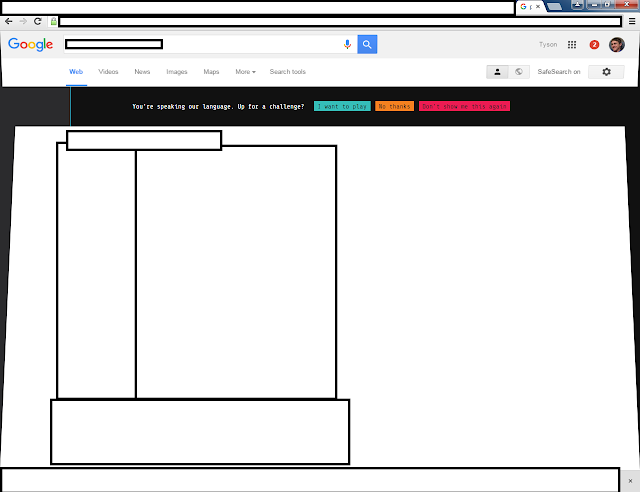
I won't give away the query that got it, but was pretty fun to see!

Monday, August 17, 2015
Back to the Future
Ok so this feels vaguely familiar all over again. I am starting classes as of today. It feels strange and exciting at the same time.
I am currently enrolled in the Artificial Intelligence for Robotics. This class is also known as Programming a robotic car. The more I'm taking the lessons the more excited I am getting about the course.
I went through the first lesson and problem set, we learned how a localization function works. I got a refresher on Bayes rule. I am sure I have a lot of learning to go, but so far I'm really optimistic.
One thing that was tripping me up a lot was figuring out which points were which in my inexact motion calculation. Additionally I was needed to make sure i accounted for Total Probability. In this case I am not going to normalize, I just multiply by all the probabilities at each of the squares as necessary.
Inexact motion is basically a way to assign probabilities to where on a grid you have moved to based on your starting point, and direction. If you overshoot (meaning you should have stopped at grid spot X but you went to gridspot X+1 assuming rightward movement), it's one thing, undershoot is less, and exact is right on.
In the problem set we have a similar inexact motion condition, except in this case it's undershoot or right on. Additionally what i was doing before was moving everything THEN doing the calculation, this was throwing things off.
All in all it's a fun first lesson. Also I have heard there will be an optional hardware component....I am SOOOO excited for that, I love that part of software, when you get to interact with things.
Tyson
I am currently enrolled in the Artificial Intelligence for Robotics. This class is also known as Programming a robotic car. The more I'm taking the lessons the more excited I am getting about the course.
I went through the first lesson and problem set, we learned how a localization function works. I got a refresher on Bayes rule. I am sure I have a lot of learning to go, but so far I'm really optimistic.
One thing that was tripping me up a lot was figuring out which points were which in my inexact motion calculation. Additionally I was needed to make sure i accounted for Total Probability. In this case I am not going to normalize, I just multiply by all the probabilities at each of the squares as necessary.
Inexact motion is basically a way to assign probabilities to where on a grid you have moved to based on your starting point, and direction. If you overshoot (meaning you should have stopped at grid spot X but you went to gridspot X+1 assuming rightward movement), it's one thing, undershoot is less, and exact is right on.
In the problem set we have a similar inexact motion condition, except in this case it's undershoot or right on. Additionally what i was doing before was moving everything THEN doing the calculation, this was throwing things off.
All in all it's a fun first lesson. Also I have heard there will be an optional hardware component....I am SOOOO excited for that, I love that part of software, when you get to interact with things.
Tyson
Thursday, June 11, 2015
#50over20
What is this hash tag? Well I got tired of seeing all these #30under30, or #40under40 clubs that people are a part of. There are plenty of awesome people who are not necessarily part of these communities where they can be nominated and win (assuming it's not just a popularity contest). So here's my idea. I'm going to find 50 people I have met in person that I think are awesome. My ONLY requirement is that I have met them. That is all. I think you guys need to have some recognition. If you're tagged in my #50over20 twitter feeds, (or if you're not on twitter, well that's ok too, we'll mention you somehow). Please send me a short bio and I'll try to talk you up too. (If you don't have my email, it's my twitter @gmail.com unless it's my onaclovtech twitter account, in which case it's tyson @ well you know my domain name.
For those of you reading this thinking. Man I wish I were part of a #50over20 club... YOU CAN BE, just start your own. Tweet things with the hash tag, and just rock it. Recognize people around you that you think are deserving, or well have simply met you that you would like to call out!
Maybe I'll make it on someone's list, but if not, at least I know that there are 50 people I know who deserve to be on someone's list!
I'll be following up with a post of the "winners" :)
Thanks and have fun!
For those of you reading this thinking. Man I wish I were part of a #50over20 club... YOU CAN BE, just start your own. Tweet things with the hash tag, and just rock it. Recognize people around you that you think are deserving, or well have simply met you that you would like to call out!
Maybe I'll make it on someone's list, but if not, at least I know that there are 50 people I know who deserve to be on someone's list!
I'll be following up with a post of the "winners" :)
Thanks and have fun!
Friday, June 5, 2015
Working Around Nodejs Module Common Singleton Design Pattern
I ran into a problem a few days ago. I built this really nifty queue module. It removes elements once they're old as defined by the key "endTime" (which come to think about it, maybe that could be a future enhancement to specify how to "expire", but I digress). Here is the problem, I needed a second queue. Well I can't just require my queue module in because it's cached and well it's not a "new" instance.
So for example.
var queue = require('queue.js');
var queue2 = require('queue.js');
queue.add({endTime : 1234});
queue2.add({enddTime : 2345});
// Assume queue.element returns the head of the queue
console.log(queue.element());
Output
>> {endTime : 2345}
// Assume queue.entire returns the entire queue
console.log(queue2.entire());
Output
>> {endTime : 1234}, {endTime : 2345}
So for example.
var queue = require('queue.js');
var queue2 = require('queue.js');
queue.add({endTime : 1234});
queue2.add({enddTime : 2345});
// Assume queue.element returns the head of the queue
console.log(queue.element());
Output
>> {endTime : 2345}
// Assume queue.entire returns the entire queue
console.log(queue2.entire());
Output
>> {endTime : 1234}, {endTime : 2345}
As you can see you don't get a unique queue.
I found some examples around the interwebs and gave it a try. I have a problem with the common approach shown below.
var queue = function(){
var self = this;
self.local_queue = [];
var funcs = {
add : function (obj){
...... stuff ......
},
entire : function(){
..... stuff..........
}
...
}
}
module.exports = function(){
return new queue();
}
I don't like implementing my functions IN the surrounding function (the add: function example).
I prefer the following:
var add = function(obj){
... stuff ...
}
...
...
var queue = function(){
var self = this;
self.local_queue = [];
var funcs = {
add : add,
entire : entire,
...
}
}
module.exports = function(){
return new queue();
}
The problem is that my functions were not able to reference self.
So I finally worked around this like this.
var add = function(self, obj){
... stuff ...
}
...
...
var queue = function(){
var self = this;
self.local_queue = [];
var funcs = {
add : function(obj){return add(self, obj)},
...
}
}
module.exports = function(){
return new queue();
}
If you notice now we have a self reference being passed to the function, all is now well in queue land.
Now when I require in it looks something like this.
var queue = require('./queue')
var queue1 = new queue();
var queue2 = new queue();
Now any adds and removes all affect only their own queues.
If you have a better cleaner way to implement this I'd be happy to see it.
Wednesday, June 3, 2015
My First Hour with a Chromebook
I'm excited. I do believe that a computer with all the tools you need at your fingertips exist. Why should compiling git require figuring out build resources, and installing a handful of different things, why not just be able to go to git.com/org/whatever and say I have a file, please compile, and it does it, on your machine (or optionally on their). Why do we have to fight to install software we may use intermittently?
Well in keeping with that thought, I decided my first laptop purchase in nearly 10 years (I know let the ridicule begin for a Software Developer to go so long between computer purchase), would be a Chromebook. I thought about this alot, I did *some* research, but frankly I'm a hands on kind of person. I like to get in and get dirty. So this post about my First Hour with a Chromebook, is being written on my Chromebook. I purchased the Chromebook linked to on this page. (Fair Warning: Click "Chromebook" anywhere here and you'll be taken to my Affiliates link on Amazon). It's a $250 dollar computer. I opted for the 16GB SSD, with 2 GB Ram, and HD display. From what I found online thanks to the NVIDIA Kepler GPU with 192 CUDA Cores and a few other things it's got a great power profile and the transitions are like butter I read somewhere.
Developing
First things up I installed an SSH terminal as I am working on my webdvr. It works as expected, however I do plan a future post on setting up keys so I don't have to type in my password every time. Hopefully we can get a series of posts to setup a basic dev environment with these tools configured to make things easier and faster.
Second install was Caret. I read this is a GREAT editor with a Sublime like interface (I have heard enough people praise Sublime I was interested). I haven't gotten deep into configuring, but once I do, this will be another post as well.
I finally tried opening a file from my raspberry pi. You can "add service" in the Caret Open File dialog. Once I selected SFTP, entered my credentials (Also future post about setting up keys for this). I was connected and running. Now for some reason while I was trying to copy a file and paste a copy (so I could rename and use again), the connection got flaky, and I decided to close the connection to my pi. This is where things were "weird" for me. When I clicked Open in Caret I was expecting the ability to essentially remount my drive and keep going, since that's what I did the first time. This was wrong (I have a question with the developer if this is expected behavior, I'll report back if it is/not), you need to find the SFTP service again from your system mount again, and THEN the folder will be visible again. I find this unexpected, and I get if Caret has no control, but seems like it would be nice to have. Aside from this, thus far, I really like the Chromebook for developing. I haven't searched but I expect I can find a Diff tool (similar to Beyond Compare) in the Web Store.
Looking at Carets github wiki they mention following the Unix Philosophy, wherein a bunch of small utilities able to be chained. I love that and think it works. In fact as I begin to use this system more and more, I am sure there will be some "small utilities" I'd like to build.
Movies
Ok so For some of my friends the question of whether Amazon Instant Video works or not. The answer is a resounding YES. Does the site need some love, yes. I guess browsing amazons regular site works but it would be nice if they had a "instant video" specialized site, that worked similar to their roku app. (Which I guess maybe it is close enough, but just feels like some UI improvement could be possible).
Things that will take getting used to
I normally am used to the "delete" key in the upper right. Now it's the power button. Gotta be careful with that one, but frankly everything is synced, it's a 10 second or less boot, really not a big deal.
I'm not sure the "proper" right click, but I've found that ALT and a click accomplishes the same thing.
I'm told Apple folks are pretty used to the two finger scrolling. I am not, (I haven't owned an Apple laptop ever), so I'm sure there are some scrolling features I'll have to learn, but this one appears to have two finger scrolling.
More eventually.
Future Plans
I plan to install nodejs locally. (for when I need to do offline development).
I plan to get a Sandisk UltraFit low profile USB memory to both boost my RAM (using virtual Ram) and to boost my HDD space in the event I need it, which if I'm developing locally I suspect I may run into a space issue. I really like the SanDisk Extreme CZ80 but it's a bit "big" for a laptop like this. If you're aware of an SD card that has speed like the above mentioned drives thats an even more ideal scenario.
I have tried a few of the android IDE's and they kinda work, but they're just not quite there for me the last time I tried. I'll probably try them first before trying to setup locally.
I plan to setup Android App Development (at least try it) eventually. I am nervous about speed, but this is much faster than my netbook so that should be less of an issue.
I'd really like to see if I can connect an Arduino to this and actually program it (Fair Warning, I haven't researched if it's been done before). I think ideally to me, if you could make a webapp that interacted with it, that would be key. I mean we can install linux tools on here all day, but that defeats the purpose of this device. Same goes for the Android IDE. Building something that uses the native ecosystem just seems right to me. Plus it'd be handy to be able to have an always updated, and always working "install" of a program. I hate trying to wade through configuration. Just give me a site. If I need to pipe into another program, let me decide when I get there (and/or give suggestions along the way).
Final Thoughts
I really like this device, it's sleek and works well. It's a really reasonable price, the screen is crisp and clear (unlike my 10 year old Dell...hahah). I truly believe this is the future of a computer and what Puppet, Vagrant, etc are all trying to accomplish with VM's. I guess we'll see where we are in a year or two. I hope that I am able to contribute to this future. If Firefox came out with a REASONABLY priced device (similar to this) I fully expect I would give it a try. I tried the Firefox Phone and unfortunately the jump from an android to it was tough. I think it's got a ton of potential though, and I'm very interested in it's future.
So that's basically my first hour with a Chromebook. I hope you had fun. Leave me a comment if you have any questions.
*Hey anyone reading this, a battery profile would be pretty slick to see, I.E. Time since charged, and all that jazz for someone interested in a 11-13 Hour battery life. Harder to keep track when you use it an hour here and an hour there. I think Android has something like this, but I don't see anything obvious here. But I digress.
Well in keeping with that thought, I decided my first laptop purchase in nearly 10 years (I know let the ridicule begin for a Software Developer to go so long between computer purchase), would be a Chromebook. I thought about this alot, I did *some* research, but frankly I'm a hands on kind of person. I like to get in and get dirty. So this post about my First Hour with a Chromebook, is being written on my Chromebook. I purchased the Chromebook linked to on this page. (Fair Warning: Click "Chromebook" anywhere here and you'll be taken to my Affiliates link on Amazon). It's a $250 dollar computer. I opted for the 16GB SSD, with 2 GB Ram, and HD display. From what I found online thanks to the NVIDIA Kepler GPU with 192 CUDA Cores and a few other things it's got a great power profile and the transitions are like butter I read somewhere.
Developing
First things up I installed an SSH terminal as I am working on my webdvr. It works as expected, however I do plan a future post on setting up keys so I don't have to type in my password every time. Hopefully we can get a series of posts to setup a basic dev environment with these tools configured to make things easier and faster.
Second install was Caret. I read this is a GREAT editor with a Sublime like interface (I have heard enough people praise Sublime I was interested). I haven't gotten deep into configuring, but once I do, this will be another post as well.
I finally tried opening a file from my raspberry pi. You can "add service" in the Caret Open File dialog. Once I selected SFTP, entered my credentials (Also future post about setting up keys for this). I was connected and running. Now for some reason while I was trying to copy a file and paste a copy (so I could rename and use again), the connection got flaky, and I decided to close the connection to my pi. This is where things were "weird" for me. When I clicked Open in Caret I was expecting the ability to essentially remount my drive and keep going, since that's what I did the first time. This was wrong (I have a question with the developer if this is expected behavior, I'll report back if it is/not), you need to find the SFTP service again from your system mount again, and THEN the folder will be visible again. I find this unexpected, and I get if Caret has no control, but seems like it would be nice to have. Aside from this, thus far, I really like the Chromebook for developing. I haven't searched but I expect I can find a Diff tool (similar to Beyond Compare) in the Web Store.
Looking at Carets github wiki they mention following the Unix Philosophy, wherein a bunch of small utilities able to be chained. I love that and think it works. In fact as I begin to use this system more and more, I am sure there will be some "small utilities" I'd like to build.
Movies
Ok so For some of my friends the question of whether Amazon Instant Video works or not. The answer is a resounding YES. Does the site need some love, yes. I guess browsing amazons regular site works but it would be nice if they had a "instant video" specialized site, that worked similar to their roku app. (Which I guess maybe it is close enough, but just feels like some UI improvement could be possible).
Things that will take getting used to
I normally am used to the "delete" key in the upper right. Now it's the power button. Gotta be careful with that one, but frankly everything is synced, it's a 10 second or less boot, really not a big deal.
I'm not sure the "proper" right click, but I've found that ALT and a click accomplishes the same thing.
I'm told Apple folks are pretty used to the two finger scrolling. I am not, (I haven't owned an Apple laptop ever), so I'm sure there are some scrolling features I'll have to learn, but this one appears to have two finger scrolling.
More eventually.
Future Plans
I plan to install nodejs locally. (for when I need to do offline development).
I plan to get a Sandisk UltraFit low profile USB memory to both boost my RAM (using virtual Ram) and to boost my HDD space in the event I need it, which if I'm developing locally I suspect I may run into a space issue. I really like the SanDisk Extreme CZ80 but it's a bit "big" for a laptop like this. If you're aware of an SD card that has speed like the above mentioned drives thats an even more ideal scenario.
I have tried a few of the android IDE's and they kinda work, but they're just not quite there for me the last time I tried. I'll probably try them first before trying to setup locally.
I plan to setup Android App Development (at least try it) eventually. I am nervous about speed, but this is much faster than my netbook so that should be less of an issue.
I'd really like to see if I can connect an Arduino to this and actually program it (Fair Warning, I haven't researched if it's been done before). I think ideally to me, if you could make a webapp that interacted with it, that would be key. I mean we can install linux tools on here all day, but that defeats the purpose of this device. Same goes for the Android IDE. Building something that uses the native ecosystem just seems right to me. Plus it'd be handy to be able to have an always updated, and always working "install" of a program. I hate trying to wade through configuration. Just give me a site. If I need to pipe into another program, let me decide when I get there (and/or give suggestions along the way).
Final Thoughts
I really like this device, it's sleek and works well. It's a really reasonable price, the screen is crisp and clear (unlike my 10 year old Dell...hahah). I truly believe this is the future of a computer and what Puppet, Vagrant, etc are all trying to accomplish with VM's. I guess we'll see where we are in a year or two. I hope that I am able to contribute to this future. If Firefox came out with a REASONABLY priced device (similar to this) I fully expect I would give it a try. I tried the Firefox Phone and unfortunately the jump from an android to it was tough. I think it's got a ton of potential though, and I'm very interested in it's future.
So that's basically my first hour with a Chromebook. I hope you had fun. Leave me a comment if you have any questions.
*Hey anyone reading this, a battery profile would be pretty slick to see, I.E. Time since charged, and all that jazz for someone interested in a 11-13 Hour battery life. Harder to keep track when you use it an hour here and an hour there. I think Android has something like this, but I don't see anything obvious here. But I digress.
Wednesday, May 13, 2015
Making a simple webapp using flaskr
Most flask examples use a blog as an example. This is probably very similar (and I'm pretty sure 90% was from another tutorial) but I just wanted to show some differences.
First we create a schema, and make a database
schema.sql looks like this.
Before running that you'll need to create the initial db which can be done via the command line in the same folder as your flaskr.py file
at the command line type python
finally when you're ready, start the following file with
sudo python flaskr.py
So here is the code to run for the simple server(flaskr.py)
So if you want different data stored off, you can change your schema, and the insert/select statement.
If you don't care about storing data, (you just want to perform actions) you can ignore most of the sql related items, and just read the data and perform whatever operation
For example
Now that we have a working app.
If you want to see the app get "data"
go to your browser and type in your ip address (if you did your IP and port as your values) and the data to send for example:
So now on your python script
request.args.get('title') should pull out "you rock" and
request.args.get('text') should pull out "this tutorialhopefullyhelps"
Good luck!
This is the site that I had most of my tutorial from:
http://flask.pocoo.org/docs/0.10/tutorial/schema/#tutorial-schema
And the last example some came from here:
http://blog.miguelgrinberg.com/post/designing-a-restful-api-with-python-and-flask
First we create a schema, and make a database
schema.sql looks like this.
Before running that you'll need to create the initial db which can be done via the command line in the same folder as your flaskr.py file
sqllite3 flaskr.db < schema.sql
at the command line type python
>>This *should* create the first intance of the database.
from flaskr import init_db
init_db()
finally when you're ready, start the following file with
sudo python flaskr.py
So here is the code to run for the simple server(flaskr.py)
So if you want different data stored off, you can change your schema, and the insert/select statement.
If you don't care about storing data, (you just want to perform actions) you can ignore most of the sql related items, and just read the data and perform whatever operation
For example
Now that we have a working app.
If you want to see the app get "data"
go to your browser and type in your ip address (if you did your IP and port as your values) and the data to send for example:
http://192.168.0.1/add?text=yourock&title=thistutorialhopefullyhelps
So now on your python script
request.args.get('title') should pull out "you rock" and
request.args.get('text') should pull out "this tutorialhopefullyhelps"
Good luck!
This is the site that I had most of my tutorial from:
http://flask.pocoo.org/docs/0.10/tutorial/schema/#tutorial-schema
And the last example some came from here:
http://blog.miguelgrinberg.com/post/designing-a-restful-api-with-python-and-flask
Monday, February 16, 2015
10 Tips for an Awesome Technical Resume
I've been asked a few times about providing tips regarding resumes. I'd like to provide them here.
- GPA is a must for some companies, keep it on if it's above 3, off if it's below (but know who you're applying to, if they care about GPA then you'll need to give it eventually).
- Don't use your school's email address on your resume. If companies don't have any openings but like you, they may not be able to get in contact with you in 2 years when they do if you use myname@unm.edu on your resume.
- Personal Email addresses should be professional looking. If you have an email account that has inappropriate words in the name, email is cheap, get a new address, you can link to your main account if you need to, but don't put dogpoo@gmail.com for your contact info.
- Quantitative, Quantitative, Quantitative. I think it bears repeating.
I supported Einstein creating the Theory of Relativity, did you get him coffee, or tell him the secrets to the universe. I might hire the person but I would need to know if they make good coffee, or change the world first.
- Anything that is older than 8-10 years not related to what you're applying to, remove it. Generally if it's not useful to show a potential employer you had a paper route, leave it off.
- I would generally exclude Office, and Windows and probably iOS as "skills" employers expect you to know those two, and you don't need to explicitly state it. Linux is good to mention somewhere.
- Your intro shouldn't be "I want job x, with company y for reason z". That's boring and most hiring people are probably going to jump over it, instead opt for an intro. Tell people about yourself and what things you're interested in (this should typically be someone related to the job).
- Be concise, keep the resume to 1 page. It's amazing how many new grads straight out of college have bolstered their resume to 4 pages. I would dare say, with almost any amount of experience aim for 1 page.
- You don't need to break up your current job by project, and/or year.
- Remove redundant data. If you've written requirements on 3 projects, specify only that. You don't need to specify all 3 projects and what you did for each specific one.
If you want to take a look at my "sort of living"
resume check out http://onaclovtech.com/
Above all, a resume is a piece of paper that attempts to give you an opportunity to talk to someone in person. Your goal is to give people something easy to read, that makes them want to talk to you at the end (or even mid ways through ;)).
Tuesday, December 23, 2014
Building your own DVR Part II
This is a continuation from Raspberry Pi + HD Homerun Dual = OTA Dvr
The original post here was outdated and I decided to remove it.
There will be future posts but it's slow going.
This is going to be a very step by step tutorial as I go through things :)
The original post here was outdated and I decided to remove it.
There will be future posts but it's slow going.
This is going to be a very step by step tutorial as I go through things :)
Monday, December 22, 2014
Raspberry Pi + HDHomeRun Dual = OTA DVR
My latest project has involved working towards a cord cutting world.
Lets get started.
The Parts
(prices as of current posting)
35.09 Raspberry Pi Model B+ (I initially used, Raspberry Pi Model B but don't expect any difference)
About $10 Research your own microsd card (for Model B I used this, I will post what I use when I get my B+)
18.99 Powered USB Hub (Any version should work, I just picked something cheap)
110.77 HDHomeRun Dual (There is an upgrade the HDHomeRun Connect-2, I haven't tried it but if you're feeling luck here's the link HD Homerun Extend-2, looks like it'll encode to other formats which is nice).
45.74 HD Antenna (This one picks quite a few channels up and has worked really well thus far, Antennaweb.com recommended a different one, but after adding a mount it was more than this one).
47.99 Router (I'm using the WRT54G because it was a spare one I had on hand).No Longer Needed.
64.99 1 TB Harddrive (I had an existing one, so some of these costs I'm not accounting for myself so my break even is sooner)
This comes out to a grand total of about $300. In my case I pay around $28 per month for my Dish Network Subscription. This means it'll take to about 12 months and I'll be ahead for costs (assuming I buy everything at once, and don't have spare parts I can just use).
Setup
The HD Home Run Dual is a REALLY Easy piece of equipment to use. All I did was plug it into the wall, plug into the router, and plug into the antenna.
You ABSOLUTELY need to be connected over ethernet with the raspberry pi (So NO raspberry pi Model A since it doesn't have an ethernet port).
I installed Rasbian (at some point in the past).
For the setup I booted into LXDE, (login and type startx).
I found this useful to remove a few unnecessary programs, but since we have a powered usb hub we are going to be storing the data on an external drive as the size of the saved file is a bit large.
http://www.sbprojects.com/projects/raspberrypi/tweaks.php
The Raspberry Pi will also need the following:
Download libhdhomerun, HDHomeRun Config GTK from here:
http://www.silicondust.com/support/downloads/linux/
Here is a GIST of the commands I used after I downloaded and extracted the above zip files, and I entered into the hdhomerun_config_gui folder.
Finally I ran the following to test that the tuner was running.
hdhomerun_config_gui
I then updated the firmware on the tuner (Disclaimer, do so at your own risk, not sure if it's required, but I did it).
Clicking on the Update tab, you can select the firmware also downloaded from Silicondust website above,
If you're using the DUAL it should be this driver: HDHR3-US (hdhomerun3_atsc).
If you're using the Extend you'll have to research which version of the firmware is right.
Recording
At this point I believe I exited the gui and re-opened it once I got the firmware updated (I got worried for a split second cause it couldn't find my tuner anymore, but it was something as simple as that to get going again). I was able to scan and see some channels and click on View to see them playing.
If you note on the left side the name of the tuner is listed (I believe it's id - 0,1), you'll need this number, also if you type hdhomerun_config discover via command line you should be able to get it right.
My general process for recording TV is this: (may be improved in the future)
1. Set Channel
2. Save Stream for some period of time.
3. Open Handbrake and transcode to another format.
I decided to just save the default format of the stream (TS?).
Looking at the developer gui You will see there is the ability to pipe into another program.
As of right now I believe that the "save" command will basically just write bytes to a file. So there is very little processing overhead happening, adding transcoding into the mix might be too much for the pi (but may not be, I really haven't verified).
I haven't tried it but you MAY be able to record BOTH tuners from one raspberry pi at a time.
Here is the single line command I used to record something last night, I'll explain what each means in a minute.
date; sleep 3600; date; hdhomerun_config set /tuner0/channel auto:27; timeout 3700 hdhomerun_config save /tuner0 test_show.ts;
Ok so I'll break down each section.
date prints the date/time
sleep will sleep the number of seconds allocated, I put in the dates around to verify it is waiting the right amount of time, and it appears to be.
hdhomerun_config ID set /tuner0/channel auto:27; This will set the first tuner to channel 27 auto selecting the modulation
timeout 3700 run a command for just over an hour (When I ran the .ts file, it was usually a little shorter than the timeout time, so I just expand it over a bit, you can edit it back if you need to using video editing software).
hdhomerun_config save /tuner0 test_show.ts; This is what actually saves your OTA channel.
Keep an eye out for a future post, I'm planning on building a NODEJS server that will allow me to schedule recordings from the internet this will be similar to my post about controlling my roku/chromecast from the internet, I'll be using Firebase as an intermediary. (I'd love to go full on DVR solution but just worry MythTV or some other equivalent would be too heavy).
Lets get started.
The Parts
(prices as of current posting)
35.09 Raspberry Pi Model B+ (I initially used, Raspberry Pi Model B but don't expect any difference)
About $10 Research your own microsd card (for Model B I used this, I will post what I use when I get my B+)
18.99 Powered USB Hub (Any version should work, I just picked something cheap)
110.77 HDHomeRun Dual (There is an upgrade the HDHomeRun Connect-2, I haven't tried it but if you're feeling luck here's the link HD Homerun Extend-2, looks like it'll encode to other formats which is nice).
45.74 HD Antenna (This one picks quite a few channels up and has worked really well thus far, Antennaweb.com recommended a different one, but after adding a mount it was more than this one).
64.99 1 TB Harddrive (I had an existing one, so some of these costs I'm not accounting for myself so my break even is sooner)
This comes out to a grand total of about $300. In my case I pay around $28 per month for my Dish Network Subscription. This means it'll take to about 12 months and I'll be ahead for costs (assuming I buy everything at once, and don't have spare parts I can just use).
Note: I didn't include powering the Raspberry pi in this calculation of cost, I plan to see if I can plug directly into the powered usb hub, and plug in the HDD from there, but I don't know for sure on that, however it uses the same plug as MOST new phones out there these days, so you probably already have a cable. (one can be found here though)
Setup
The HD Home Run Dual is a REALLY Easy piece of equipment to use. All I did was plug it into the wall, plug into the router, and plug into the antenna.
You ABSOLUTELY need to be connected over ethernet with the raspberry pi (So NO raspberry pi Model A since it doesn't have an ethernet port).
I installed Rasbian (at some point in the past).
For the setup I booted into LXDE, (login and type startx).
I found this useful to remove a few unnecessary programs, but since we have a powered usb hub we are going to be storing the data on an external drive as the size of the saved file is a bit large.
http://www.sbprojects.com/projects/raspberrypi/tweaks.php
The Raspberry Pi will also need the following:
Download libhdhomerun, HDHomeRun Config GTK from here:
http://www.silicondust.com/support/downloads/linux/
Here is a GIST of the commands I used after I downloaded and extracted the above zip files, and I entered into the hdhomerun_config_gui folder.
Finally I ran the following to test that the tuner was running.
hdhomerun_config_gui
I then updated the firmware on the tuner (Disclaimer, do so at your own risk, not sure if it's required, but I did it).
Clicking on the Update tab, you can select the firmware also downloaded from Silicondust website above,
If you're using the DUAL it should be this driver: HDHR3-US (hdhomerun3_atsc).
If you're using the Extend you'll have to research which version of the firmware is right.
Recording
At this point I believe I exited the gui and re-opened it once I got the firmware updated (I got worried for a split second cause it couldn't find my tuner anymore, but it was something as simple as that to get going again). I was able to scan and see some channels and click on View to see them playing.
If you note on the left side the name of the tuner is listed (I believe it's id - 0,1), you'll need this number, also if you type hdhomerun_config discover via command line you should be able to get it right.
My general process for recording TV is this: (may be improved in the future)
1. Set Channel
2. Save Stream for some period of time.
3. Open Handbrake and transcode to another format.
I decided to just save the default format of the stream (TS?).
Looking at the developer gui You will see there is the ability to pipe into another program.
As of right now I believe that the "save" command will basically just write bytes to a file. So there is very little processing overhead happening, adding transcoding into the mix might be too much for the pi (but may not be, I really haven't verified).
I haven't tried it but you MAY be able to record BOTH tuners from one raspberry pi at a time.
Here is the single line command I used to record something last night, I'll explain what each means in a minute.
date; sleep 3600; date; hdhomerun_config set /tuner0/channel auto:27; timeout 3700 hdhomerun_config save /tuner0 test_show.ts;
Ok so I'll break down each section.
date prints the date/time
sleep will sleep the number of seconds allocated, I put in the dates around to verify it is waiting the right amount of time, and it appears to be.
hdhomerun_config ID set /tuner0/channel auto:27; This will set the first tuner to channel 27 auto selecting the modulation
timeout 3700 run a command for just over an hour (When I ran the .ts file, it was usually a little shorter than the timeout time, so I just expand it over a bit, you can edit it back if you need to using video editing software).
hdhomerun_config save /tuner0 test_show.ts; This is what actually saves your OTA channel.
Note: Remember to navigate to your external hard drive when you run this (you may be able to point the .ts file to the path, but I haven't tried it), otherwise you'll run out of memory pretty fast. When I recorded about 4.5 hours it came out to 26.1 GB of data. Transcoding down should come out to 5-7 GB so it'll go quite a bit down (using Normal on Handbrake and MKV, other settings may come out smaller).Good luck and let me know what you come up with!
Keep an eye out for a future post, I'm planning on building a NODEJS server that will allow me to schedule recordings from the internet this will be similar to my post about controlling my roku/chromecast from the internet, I'll be using Firebase as an intermediary. (I'd love to go full on DVR solution but just worry MythTV or some other equivalent would be too heavy).
Tuesday, November 25, 2014
Automated Email Form Part 2
Continuing our post from Automated Email Form Part 1.
Now you have a trigger setup in Zapier, lets setup the webpage to send an email to yourself.
First lets add an input field to your webpage like so:
If you notice I left name in there, but i'm not collecting names, I decided the less a user has to type the lower the barrier to contacting me in this case. Maybe one day I'll add a name if I feel its necessary, but just adding one more field with the NG model set to name would capture the users name for yourself.
Basically I setup an NG-Click to call a function in my angularjs code.
So while in some cases you could put your angularjs code in html, most of the time you put it in a .js file, (I'm putting in the .html so there are script tags surrounding, but generally don't do that, unless it's a REALLY simple app, which in this case it is).
If you notice I do a simple regex email validate check.
When it passes it pushes the email address to my firebase link, next Zapier picks up the change and sends you an email.
Pro Tip: In fact I almost forgot I had it setup and when I received an email with the submitted email, I got really confused. so DON'T forget to make the subject easily recognizable, otherwise you might run into the same case :)
Good luck and let me know how it works for you!
Now you have a trigger setup in Zapier, lets setup the webpage to send an email to yourself.
This will be an AngularJS app, so add the appropriate pieces to make it work. (you can look at angularjs.org or many online tutorials for specifics).
First lets add an input field to your webpage like so:
If you notice I left name in there, but i'm not collecting names, I decided the less a user has to type the lower the barrier to contacting me in this case. Maybe one day I'll add a name if I feel its necessary, but just adding one more field with the NG model set to name would capture the users name for yourself.
Basically I setup an NG-Click to call a function in my angularjs code.
So while in some cases you could put your angularjs code in html, most of the time you put it in a .js file, (I'm putting in the .html so there are script tags surrounding, but generally don't do that, unless it's a REALLY simple app, which in this case it is).
If you notice I do a simple regex email validate check.
When it passes it pushes the email address to my firebase link, next Zapier picks up the change and sends you an email.
Pro Tip: In fact I almost forgot I had it setup and when I received an email with the submitted email, I got really confused. so DON'T forget to make the subject easily recognizable, otherwise you might run into the same case :)
Good luck and let me know how it works for you!
Tuesday, September 23, 2014
100 year glasses
My parents crack me up. Anytime there's an argument, or concern about something they like to use the phrase
I always kinda brushed it off, and found it was useful to tell to others who were upset but not for yourself.
I was thinking about it just now and realized what if we started looking at things with 100 year glasses.
What would change, what things would matter?
I agree with Elon Musk (and I'm sure plenty of others) that becoming a multiplanetary race is a good thing.
I agree reducing our reliance on oil is a good thing (however I feel that reducing our need on energy in general is a good idea).
I agree finding a way to diagnose and resolve health issues without the need of doctors from your own home is necessary.
If resolving transportation issues is a need we as a people can and should solve it.
We should focus on furthering the human race more than helping a company making 100 billion dollars.
How can we still maintain a level of our fellow man while automating the unnecessary things? (some kind of robot to cook healthy meals for us in our own home)
If we can imagine it, and focus on it. We can build it.
Not everything should come at a cost.
What can you imagine we need built 100 years in the future with the will of our people?
Don't worry about it if it won't matter in 100 years
I always kinda brushed it off, and found it was useful to tell to others who were upset but not for yourself.
I was thinking about it just now and realized what if we started looking at things with 100 year glasses.
What would change, what things would matter?
I agree with Elon Musk (and I'm sure plenty of others) that becoming a multiplanetary race is a good thing.
I agree reducing our reliance on oil is a good thing (however I feel that reducing our need on energy in general is a good idea).
I agree finding a way to diagnose and resolve health issues without the need of doctors from your own home is necessary.
If resolving transportation issues is a need we as a people can and should solve it.
We should focus on furthering the human race more than helping a company making 100 billion dollars.
How can we still maintain a level of our fellow man while automating the unnecessary things? (some kind of robot to cook healthy meals for us in our own home)
If we can imagine it, and focus on it. We can build it.
Not everything should come at a cost.
What can you imagine we need built 100 years in the future with the will of our people?
Automated Email Form Part 1

So I have this nifty thing on my website (onaclovtech.com) that asks people to put in their email address. It then stores to Firebase. This is great except for one slight problem. I have to go check periodically if anyone added their email address.
If you actually do this it works well, however I don't always remember to (I really wasn't actually expecting any emails added for a while). Sorry to the 3 people who I discovered in fact DID use my form.
Ok, so I rambled for a bit, but really what I wanted to tell you was a way to solve your problem. Introducing Zapier. Zapier takes tasks and connects them together (very similar to IFTTT if you've ever played with it). I setup a Zap (what it's called when you connect two things together) to check when new child is added to an object in Firebase.
When a new child is added it emails me with the contacts email, and "new email submitted" in the subject line. This helps me keep on top of "new" visitors that want to chat.
Head on over to Zapier if you're interested in automating this kind of stuff.
I made a template if you use it you'll get some extra tasks I believe.
Heres the link: http://zpr.io/G6ri
NOTE: By signing up with Zapier through one of my links I'll get some bonus tasks (A. La. Dropbox style), if you do sign up and want to see whatever other ones are around check this link out: https://zapier.com/rewards/ You've been warned :)
Stay tuned for part two!
UPDATE: Part 2 is Live here --> Automated Email Form Part 2
Monday, September 22, 2014
Question Everything
Always ask why. Don't take "this is the way we've always done it" as the answer.
Take charge of your destiny. If something doesn't make sense. Don't just ask why, question everything about it.
Right now I'm working on the side trying to simplify our build process.
"Why do we need these buttons" ... "because we need to make all these variations of selections"
(After looking a little closer, the variations we selected happened pretty consistently, so guess what? a few checkboxes replace a bunch of radio buttons and other selections).
"Why do we let them select this data" .... "Because they might want to select something else"
(rarely if ever has anyone ever selected anything else)
Keeping on doing the same things because that's the way we've always done them, doesn't make your job easier, it makes it harder. We're software engineers it's in our blood to make complicated things simple and simple things complicated.
Good luck and godspeed!
Take charge of your destiny. If something doesn't make sense. Don't just ask why, question everything about it.
Right now I'm working on the side trying to simplify our build process.
"Why do we need these buttons" ... "because we need to make all these variations of selections"
(After looking a little closer, the variations we selected happened pretty consistently, so guess what? a few checkboxes replace a bunch of radio buttons and other selections).
"Why do we let them select this data" .... "Because they might want to select something else"
(rarely if ever has anyone ever selected anything else)
Keeping on doing the same things because that's the way we've always done them, doesn't make your job easier, it makes it harder. We're software engineers it's in our blood to make complicated things simple and simple things complicated.
Good luck and godspeed!
Thursday, August 28, 2014
Post JSON to Nodejs from Angularjs
I'm struggling with the title of this post as I searched many ways but couldn't find something simple like this.
If you have any other name suggestions I'm totally open!
Here goes.
I wanted to send JSON from an AngularJS app and get it on my NodeJS side so I could do something with the data.
There may be better ways (Socket.IO anyone?) but here goes:
Here is my angularJS service:
And here is my nodejs page:
Install express, and body-parser (I think that's about all) and you should be able to send a message using
$message.create({ }); // That's a JSON object being passed in
Simple AngularJS controller
And Finally a simple HTML page for it.
Good Luck!
I hope that helps SOMEONE out there.
If you have any other name suggestions I'm totally open!
Here goes.
I wanted to send JSON from an AngularJS app and get it on my NodeJS side so I could do something with the data.
There may be better ways (Socket.IO anyone?) but here goes:
Here is my angularJS service:
And here is my nodejs page:
Install express, and body-parser (I think that's about all) and you should be able to send a message using
$message.create({ }); // That's a JSON object being passed in
Simple AngularJS controller
And Finally a simple HTML page for it.
Good Luck!
I hope that helps SOMEONE out there.
Wednesday, August 20, 2014
Control your Network Connected Devices
Today I want to tell you about a little epiphany I had a few weeks back. I realized that I could connect firebase to a local nodejs server and a public facing website, and control my roku.
Most people read this and think....well duh you can already control your roku using your phone. At this time (please prove me wrong) you need to be on your Intranet. Your Intranet is the network in your house that your roku is on, so basically you have to be on the same wifi as your roku.
This means you can setup a website using firebase to authenticate you, connect to a common data point in your database and now control things in your house from ANYWHERE as long as both have an internet connection. So I could be in Hong Kong and change the channel on my roku.
Ok, big deal why should I care? Well what if I told you that your roku isn't the only device that connects to the internet? You can query for all these devices, setup commands for them, and control them from anywhere! Forgot a light on in the house when you left? With (some) devices you can check the status and turn it off/on. This kinda makes that whole "internet" of things a lot closer to reality without completely opening up your network, the only "failure" point here is if your firebase gets hacked or something.
But you want code....
Here is the side that runs in your house (and you could also just run this on a raspberry pi or something instead of a dedicated full blown computer).
Right now I have my own rolled roku controller, but I think there is one in npm already that I haven't checked out. You can control your Chromecast this way. Possibly smart tv's etc.
Details for the people who are interested:
Node Side:
1. Start server
2. Server does a query for network devices and adds them to a list.
3. Server pushes list to myfirebaseurl/mediadevices
4. Server then sets up a callback to trigger when a child changes (state specifically).
5. Server sets up functions to handle deleting devices in mediadevices when it closes (this is to ensure that the devices are always accessible).
AngularJS side:
1. Connect to myfirebaseurl/mediadevices
2. Associate NG model to a dropdown (that's how I'm swapping between, if you have other ideas I'd love to hear them).
3. When a button is pressed, it looks at which device is selected and changes it's state to whatever mode that button is designed to accomplish.
4. If the server is removed then mediadevices is empty and the dropdown goes away.
Let me know what you think! If you have a chromecast, amazontv, etc that you want to build this on, or want to lend me to build it on, lemme know I'd love to chat!
Tyson
Most people read this and think....well duh you can already control your roku using your phone. At this time (please prove me wrong) you need to be on your Intranet. Your Intranet is the network in your house that your roku is on, so basically you have to be on the same wifi as your roku.
This means you can setup a website using firebase to authenticate you, connect to a common data point in your database and now control things in your house from ANYWHERE as long as both have an internet connection. So I could be in Hong Kong and change the channel on my roku.
Ok, big deal why should I care? Well what if I told you that your roku isn't the only device that connects to the internet? You can query for all these devices, setup commands for them, and control them from anywhere! Forgot a light on in the house when you left? With (some) devices you can check the status and turn it off/on. This kinda makes that whole "internet" of things a lot closer to reality without completely opening up your network, the only "failure" point here is if your firebase gets hacked or something.
But you want code....
https://github.com/onaclovtech/MediaController
Here is the side that runs in your house (and you could also just run this on a raspberry pi or something instead of a dedicated full blown computer).
Right now I have my own rolled roku controller, but I think there is one in npm already that I haven't checked out. You can control your Chromecast this way. Possibly smart tv's etc.
Details for the people who are interested:
Node Side:
1. Start server
2. Server does a query for network devices and adds them to a list.
3. Server pushes list to myfirebaseurl/mediadevices
4. Server then sets up a callback to trigger when a child changes (state specifically).
5. Server sets up functions to handle deleting devices in mediadevices when it closes (this is to ensure that the devices are always accessible).
AngularJS side:
1. Connect to myfirebaseurl/mediadevices
2. Associate NG model to a dropdown (that's how I'm swapping between, if you have other ideas I'd love to hear them).
3. When a button is pressed, it looks at which device is selected and changes it's state to whatever mode that button is designed to accomplish.
4. If the server is removed then mediadevices is empty and the dropdown goes away.
Let me know what you think! If you have a chromecast, amazontv, etc that you want to build this on, or want to lend me to build it on, lemme know I'd love to chat!
Tyson
Friday, August 15, 2014
Can we make web apps less reliant on network?
So I was thinking a little about how I was using bootstrap for some of my sites, and with it being a pretty commonly used code across sites it got me thinking.
Could we somehow share these resources across domains reducing the need to download, which causes us to slow things down normally.
Here is my thought.
When parsing a .html file you come across a script tag with a src a la
When it downloads the file it (maybe?) puts it in memory so it can be used (I could be wrong here).
What I was thinking is that we maybe generate a key value store, and it does something like this:
{"https://cdnjs.cloudflare.com/ajax/libs/angular.js/1.2.6/angular.min.js", "pointer to memory that this resides"}
Now instead of simply downloading a .js file, it looks at the lookup (or hash table) and finds that that EXACT path file exists in memory and just uses that instead of downloading the file again.
Caveats.
1. I don't know if it would be possible to modify that memory.
2. I wouldn't expect this caching to be indefinite, but should be do-able across pages during an active session.
As long as the downloaded data isn't capable of being modified in memory, then doing a string lookup in a local hash *should* give us a decent startup decrease because we don't need to re-download the file(s) and I can't see how we would have any problems with safety/security since you're literally using the exact same file as you downloaded earlier, you just don't need to re-download.
I'm sure I'm missing something here, but I would think that this should be possible. Got any ideas? hit me up on twitter (@onaclov2000) or leave a comment here
Could we somehow share these resources across domains reducing the need to download, which causes us to slow things down normally.
Here is my thought.
When parsing a .html file you come across a script tag with a src a la
script src="https://cdnjs.cloudflare.com/ajax/libs/angular.js/1.2.6/angular.min.js"
When it downloads the file it (maybe?) puts it in memory so it can be used (I could be wrong here).
What I was thinking is that we maybe generate a key value store, and it does something like this:
{"https://cdnjs.cloudflare.com/ajax/libs/angular.js/1.2.6/angular.min.js", "pointer to memory that this resides"}
Now instead of simply downloading a .js file, it looks at the lookup (or hash table) and finds that that EXACT path file exists in memory and just uses that instead of downloading the file again.
Caveats.
1. I don't know if it would be possible to modify that memory.
2. I wouldn't expect this caching to be indefinite, but should be do-able across pages during an active session.
As long as the downloaded data isn't capable of being modified in memory, then doing a string lookup in a local hash *should* give us a decent startup decrease because we don't need to re-download the file(s) and I can't see how we would have any problems with safety/security since you're literally using the exact same file as you downloaded earlier, you just don't need to re-download.
I'm sure I'm missing something here, but I would think that this should be possible. Got any ideas? hit me up on twitter (@onaclov2000) or leave a comment here
Wednesday, August 6, 2014
Movies Oh My
I've been a busy boy.
In my quest to generate a boatload of Angular Services (for angularjsservices.com, dont hate the site it is terrible, if you want to help build it let me know!).
I wrote up another library but this time for my movies.
https://github.com/onaclovtech/movielibrary
The cool thing here is I built a rottentomatoes.js angular service for it.
https://github.com/onaclovtech/rottentomatoes
I got it all nice looking and then discovered omdbapi and guess what? now we have one for that too.
https://github.com/onaclovtech/omdbapi
You can substitute them and get your data.
Now the bad news. (but potentially good news).
The JSON returned is different between the two. So something I'm thinking about that would be really slick is if we could essentially take the format from each and push the data to a title,picture,etc variables, then we simply return our search and it contains an object with the appropriate fields in a standard location. I think this would be huge for ALL of my Angular Services to basically build a JSON format that will be consistent, and the service will manage converting.
If you're interested in helping out with coming up with standards for this I would love it. If you're interested in helping build angularjsservices to what it SHOULD be, I would love that.
In the mean time I'm building building building.
Join me and build an angular service too? (trust me they're surprisingly easy, and they make using angular even more fun)
I'm using Firebase to store off the data just like my book library. Firebase sure is handy.
While playing with this I realized something....I can control my roku with a webpage and I don't need chrome's special stuff (that the chromecast is using) I can just use a local nodejs server and firebase and host my site anywhere. I will be working on that next. Can you figure out how to do it? I think I've given some good hints :)
In my quest to generate a boatload of Angular Services (for angularjsservices.com, dont hate the site it is terrible, if you want to help build it let me know!).
I wrote up another library but this time for my movies.
https://github.com/onaclovtech/movielibrary
The cool thing here is I built a rottentomatoes.js angular service for it.
https://github.com/onaclovtech/rottentomatoes
I got it all nice looking and then discovered omdbapi and guess what? now we have one for that too.
https://github.com/onaclovtech/omdbapi
You can substitute them and get your data.
Now the bad news. (but potentially good news).
The JSON returned is different between the two. So something I'm thinking about that would be really slick is if we could essentially take the format from each and push the data to a title,picture,etc variables, then we simply return our search and it contains an object with the appropriate fields in a standard location. I think this would be huge for ALL of my Angular Services to basically build a JSON format that will be consistent, and the service will manage converting.
If you're interested in helping out with coming up with standards for this I would love it. If you're interested in helping build angularjsservices to what it SHOULD be, I would love that.
In the mean time I'm building building building.
Join me and build an angular service too? (trust me they're surprisingly easy, and they make using angular even more fun)
I'm using Firebase to store off the data just like my book library. Firebase sure is handy.
While playing with this I realized something....I can control my roku with a webpage and I don't need chrome's special stuff (that the chromecast is using) I can just use a local nodejs server and firebase and host my site anywhere. I will be working on that next. Can you figure out how to do it? I think I've given some good hints :)
Subscribe to:
Posts (Atom)